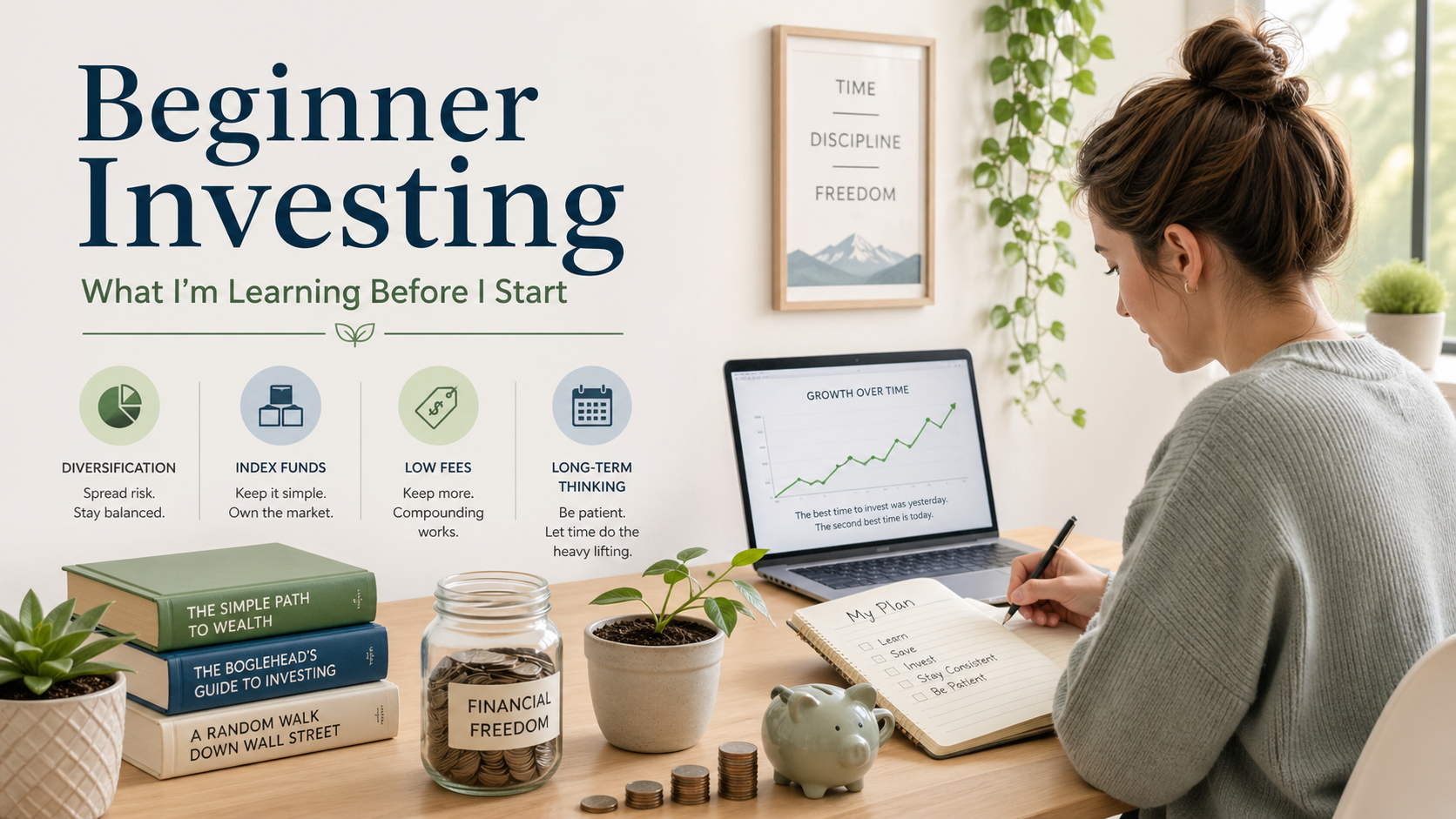
Why I’m writing about investing
I think investing is a big part of becoming financially free.
I’m still early in the process, and investing feels both interesting and a little complicated. There is a lot to learn, and it can be easy to feel like you need to understand everything before you begin.
Right now, I’m investing a small amount every month. Not because I expect to get rich quickly, but because I want to build the habit, learn by doing, and slowly create something over time.
For me, investing is not about chasing quick money. It is about building long-term freedom.
Why investing matters for financial freedom
Saving money is important, but saving alone may not always be enough to reach financial freedom — or it may take a very long time.
A savings account gives stability and easy access to money, which is important. But the interest on a savings account is often lower than the potential long-term return from investments like funds, property, or even a good business opportunity.
Of course, higher potential returns usually come with higher risk. That is why I think it is important to understand the basics before investing too much.
For me, the simple idea is this:
Saving gives me more control in the short term.
Investing can help me build more wealth in the long term.
What I used to think about investing
I have always liked the idea of investing, but for a long time I thought I needed a lot of money before I could start.
I also didn’t really have much money saved to invest with. That made me realize something important: saving is the foundation.
Before I can invest seriously, I need control over my money. I need money for bills, daily life, unexpected expenses, and short-term goals.
But I’m also learning that I don’t need to wait until everything is perfect. I can start small while I continue saving. Even a small monthly investment can help me build the habit and learn more about how investing works.
That combination — saving and investing — feels powerful to me.
What I’m learning now
Investing is long-term:
I’m trying to forget the idea of getting rich quickly. That mindset can easily lead to bad decisions. Instead, I want to think about investing as something slow, steady, and long-term. The goal is to build something lasting and worthwhile.
Risk is normal, but it can be managed:
Risk is part of investing. Investments can go up and down in value, and there is always a chance that I will not get the return I hoped for.
But risk can be managed.
One way to reduce risk is diversification, which means spreading money across many different investments instead of putting everything in one place.
Another important rule is to only invest money I do not need soon.
Index funds seem beginner-friendly
Right now, I’m investing in a fund, and index funds are one of the things I’m trying to understand better.
To me, index funds seem beginner-friendly because they are simple, diversified, and often have lower fees than many actively managed funds.
They are usually less risky than buying only one or two single stocks, because the money is spread across many companies. But that does not mean they are risk-free. They can still fall in value, especially in the short term.
Time matters more than perfection
I’m learning that I do not need to know everything before I start.
Of course, I should understand the basics. But if I wait until I feel like an expert, I might never begin.
Starting small gives me a way to learn without taking too much risk.
What I want to understand before I invest
I don’t think I need perfect knowledge before investing, but I do think some basic understanding is important.
These are some of the things I want to understand better.
What is a fund?
A fund is a collection of many investments, such as stocks or bonds, gathered into one product.
When I invest in a fund through my bank, my money is spread across many companies or assets instead of just one. This can help reduce risk.
In simple terms: buying a fund is like buying a small piece of a large investment basket.
What does risk actually mean?
In investing, risk means the chance that an investment can go down in value or not give the return I hoped for.
For example, if I invest 1,000 kr in a fund, it might grow over time — but it could also fall in value for a while.
Higher risk usually means bigger ups and downs, but also a higher chance of better returns over the long term. Lower risk usually means smaller ups and downs, but often lower returns.
How do fees work?
Fees are the costs I pay to invest.
For funds, the most common fee is a yearly percentage fee, often called a management fee or expense ratio.
For example, if I invest 1,000 kr in a fund with a 1% yearly fee, I pay about 10 kr per year.
That may not sound like much, but fees matter over time. A small difference in fees can become a big difference after many years.
In simple terms: lower fees usually mean more of my money stays invested for me.
What does diversification mean?
Diversification means spreading money across many different investments instead of putting everything in one place.
For example, instead of investing in only one company, I can invest in many companies, industries, or countries.
In simple terms: don’t put all your eggs in one basket.
Diversification does not remove all risk, but it can reduce the risk that one bad investment hurts the whole portfolio.
How much can I afford to invest?
Before investing more, I need to look at my income, expenses, and financial situation.
Before investing, I want to make sure I have:
- Money for bills and daily life
- An emergency fund for unexpected costs
- No high-interest debt that should be paid down first
- Money set aside for short-term goals
After that, I can invest money I do not need soon — ideally money I can leave invested for several years.
In simple terms: I should invest what is left after my needs, safety buffer, and short-term goals are covered.
How can I stay calm when the market goes down?
Markets go up and down. That is normal.
When the market falls, I want to remind myself of the long-term plan instead of reacting emotionally to daily changes.
If I invest in diversified funds and do not need the money soon, short-term drops are usually part of the journey.
In simple terms: I do not want to panic-sell just because the market is temporarily down. Panic-selling can turn a temporary drop into a real loss.
My current investing plan
Right now, I’m putting 10% of what I spend with my card into a savings account. From that account, 450 kr is automatically invested into a fund every month.
This means I’m both saving and investing at the same time.
I like this system because it feels simple. I’m building an emergency fund while also creating the habit of investing every month.
The amount is not huge, but that is okay. The goal right now is to learn, stay consistent, and slowly build momentum.
Mistakes I want to avoid
Investing money I need soon
I do not want to put all my money into investment funds and ignore my savings.
If something unexpected happens, I need money I can access quickly. That is why I want to keep building my savings while investing small amounts on the side.
Copying random advice from social media
There is a lot of financial advice online, but not all of it is good.
Some people make investing sound easy because they want attention, views, or sales. I want to be careful with advice that promises quick results.
I use tools like ChatGPT to learn and understand concepts, but I still want to think critically and check information from reliable sources.
Buying something just because it is hyped
I do not want to invest in something just because a lot of people on TikTok, YouTube, or social media are talking about it.
If I invest in something, I want to understand why.
Doing my own research is part of the learning process.
Panic-selling when prices fall
Panic-selling is something I really want to avoid.
If I sell when prices are low, I lock in the loss. But if I stay invested, the market may recover over time.
Of course, there are situations where selling can make sense, but I do not want fear to be the reason I sell.
Thinking investing will fix bad money habits overnight
Investing is not magic.
If I have bad money habits, investing alone will not fix everything. I still need to save, budget, avoid unnecessary debt, and make better daily decisions.
Good habits take time. I want to be patient with myself and focus on progress, not perfection.
What This Means for My Financial Freedom Journey
Saving gives me control and a feeling of stability. It helps reduce stress and worry in my life.
Investing gives me hope for the long term. It reminds me that small actions today can grow into something bigger over time.
If I can also build multiple sources of income, that could help me reach financial freedom faster.
But the foundation is still the same: financial knowledge, better habits, patience, and consistency.
Conclusion: Learning before rushing
I’m still at the beginning, and that is okay.
My goal is not to pretend I know everything. My goal is to learn, take small steps, and document the journey honestly.
If you are also new to investing, I hope this blog can be a place where we learn step by step together.
New to Freedom With Markus?
Start with my Start Here page for a simple roadmap to saving money, beginner-friendly investing, and building extra income over time.
And before investing, I believe it is important to build a strong money foundation. That is why I recommend reading How to Start Saving Money When You’re Broke.
This blog is part of my personal journey toward financial freedom. You can also read more about why I started it on my About Me page.
What about you?
What is one small financial habit you’re trying to improve right now? Let me know in the comments!